
Stephan Bredell is the kind of entrepreneur who doesn’t wait until everything is known before he begins. He founded Plato Coffee with his brother, after he recognizing the attractive margins achieved of coffee He was working in marketing at an insurance business at the time.
When he and Petrus launched Plato in 2018, neither of them had a formal background in coffee. What Stephan did have was a marketer’s instinct for design, and his brother a systems thinker’s grip on operations. They a shared conviction that South Africa’s coffee scene was ripe for reinvention. Plato founders Stephan and Petrus Bredell:
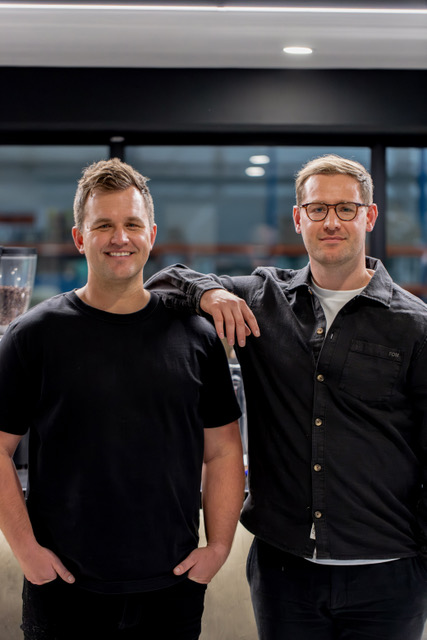
Plato has opened 105 stores in about six years, and serves a million espresso shots a month. The brand sits at about 11% market share in a field dominated by Vida e Caffe and Seattle Coffee Company. With 133 stores open, another four launching this month, and 50 more planned before year’s end. The brand has more outlets than Starbucks in the country.
“We didn’t know anything about coffee, really. Hence the slogan: Just Coffee, sculpted. We figured it out as we went,” says Bredell.
Walk into a Plato and the first thing you notice is what isn’t there. There are no exposed brick walls, no Edison bulbs, no salvaged timber. The steam-punk industrial look that swept through South African coffee culture over the past 15 years – wood, steel, moody lighting, artful clutter – is conspicuously absent. Instead, Plato’s spaces are luminously white, architecturally spare, and almost shockingly clean.
Bredell describes the aesthetic as South Korean and Japanese-inspired, a deliberate pivot away from what other local brands were doing. He wanted to create something like an Apple Store. Whether or not you are an Apple devotee, he argues, you feel something walking in: aspiration, clarity, calm.
“A lot of people said, it’s too cold, it’s too clinical, coffee shop needs to be cosy,” he recalls. “We just literally went the other route. It was a gamble. But I think it’s refreshing.”
The bet has paid off in ways that extend beyond aesthetics. White walls require upkeep. Customers notice. For a brand selling food and drink, the subliminal message – this place is clean – turns out to be a powerful one.
The coffee itself was developed through a process in which they figured it out as they went along. He and his brother attended a few coffee-making courses. Bredell describes his brother as meticulous by nature. Today Plato runs its own roastery Plato Supplies, which provides beans and a central kitchen operation of the entire franchise network. The business model is very much vertically and horizontally integrated.
The brothers noticed that South Africans, broadly speaking, have a sweet palate – they as Afrikaans were raised on milk tart, malva pudding, and koeksisters. Rather than fighting that instinct, they leaned into it, engineering a house blend designed to be naturally sweet and easy drinking.
It’s very much and ‘easy drinking philosophy’. The blend draws on Central African and Central American origins – Kenyan or Ethiopian for bright acidity, Colombian and Guatemalan and Nicaraguan for caramel and chocolate depth. The goal was something balanced and complete, a cup you could finish and immediately want another.
What has surprised the team is how this philosophy has educated smaller-town markets. In towns like Kimberley and Rustenburg, where specialty coffee was essentially unknown, customers who started by loading their drinks with syrups and sugars have slowly discovered they no longer need to. “People are realizing that if it’s properly extracted, you can actually drink it without six sugars,” he says. “That’s a beautiful thing to watch.”
Theirs is a franchise business model in which community is part of the strategy. The core principle is that the franchisee must be embedded in the community the store serves. Plato actively seeks out what Bredell calls community builders- people who are known, trusted and invested in the neighbourhood. He illustrates the point with the example of a local physiotherapist who has worked in her town for 25 years (Gerda), watched generations of children grow up, and is woven into the social fabric of the place. When she opened, it didn’t feel like a chain arriving from Johannesburg.
“People support people,” he says. “We want to create a big brand feel but it still feels independent. It still feels local.”
The model enforces this at a structural level. Plato caps franchisees at three stores. More than that and the owner loses the operational intimacy that makes the model work. There is no provision for a silent investor to own a store while a hired manager runs it – unless that manager holds at least a 25% equity stake. Skin in the game, as Stefan puts it, is non-negotiable.
Increasingly, Plato is moving toward joint venture structures for new store openings, with the group holding 51% and the franchisee 49%. The model has a logic: the franchisee contributes capital alongside the group’s equity stake, the bank funds the remainder, and both parties share in the dividends. A franchisee who might once have been able to open one store can now open three.
Coffee, done right, is a remarkable business, he says. Bredell puts flat whites at roughly 70% gross profit; frozen drinks closer to 50%. A well-run Plato store, with pastries and food items in the mix, should be targeting 55% to 60% gross profit – numbers that most retail categories would regard as extraordinary.
Owning the roastery gives Plato a structural advantage.
That means every kilogram of beans sold to a Plato franchisee generates margin at the supply level before the royalty on revenue is even calculated. The group can choose to pass some of that saving through to franchisees, keeping their economics healthy, without sacrificing its own returns.
The model also means Plato can price its product accessibly – while still maintaining the financial discipline that makes franchising viable long-term.
Perhaps the most striking thing about Plato’s rise is how little conventional advertising has driven it. In the early days, the approach was entirely organic: the brand reshared every tagged story on Instagram, turning customers into content creators and amplifying their audiences alongside its own. The result was a growing community of people who felt genuine ownership of the brand.
Today Plato has the second-largest coffee Instagram following in South Africa, approaching 100 000 followers. The brand runs targeted digital advertising through Google and Waze – if you search “coffee shop near me” in a Plato market, it will find you – and sells localized digital marketing packages to franchisees for their individual stores. But the foundation remains the same community logic that began when the brand had no budget.
Between December and the end of June last year, the company received over a thousand franchise applications without running single franchise marketing campaign. Bredell had to close applications: there were only 60 sites available in the year.
London is the next frontier: Bishop’s Gate, EC2, 300 metres from Liverpool Street Station. A shop – not even three metres deep – in the same building that houses Gordon Ramsay’s latest restaurant venture. It opened in April. “If it doesn’t work there, then we’re not going to make it in London,” he says. Images of the London store:
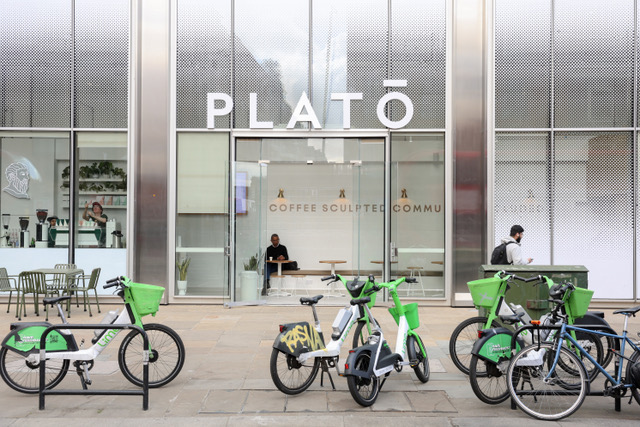
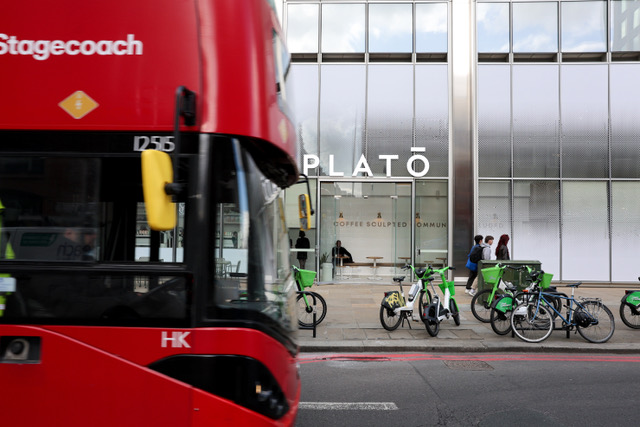
The commercial logic for the move is straightforward. South Africa has a population of about 60-million people, of whom perhaps six million can readily afford a R40 cappuccino. Greater London alone has over 200 Starbucks outlets. The spending power is simply incomparable. A top-performing Plato in South Africa serves around 700 cups a day. The best independent coffee shops in London do closer to a thousand – and charge more.
The lease, signed at around £35 000 a year, cost less than a third of what equivalent city-centre space might typically command. The store will operate two points of sale and two espresso machines simultaneously, essentially running as two shops in one unusually configured space.
After Bishop’s Gate, the plan is to open a second London location by October or November, with Wimbledon cited as an area of interest. And beyond London, the Netherlands has generated the second-highest volume of international franchise enquiries after South Africa. There has been serious conversation about Florida and Tennessee. Whether international growth happens through franchise or joint venture will depend, as always in the Plato story, on finding the right people in the right communities.
Stefan can’t fully explain how the rampant growth happened. He suspects it’s a combination of product, design, community selection, and something harder to name.